
Sovereign by Design: The Strategic Case for On-Premises Voice AI in Government Operations
Executive Summary
Governments worldwide are modernizing their contact centers with artificial intelligence, driven by the promise of continuous availability, consistent service quality, and significant cost reductions. Yet, for governments in the Gulf region—and Saudi Arabia in particular—this modernization agenda collides with a stark reality: commercial voice AI is built for the public cloud, while government data is strictly sovereign.
This structural mismatch places public-sector leaders in a difficult position. Citizens expect immediate, accurate responses in their local dialects. Regulators demand that citizen data remain within national jurisdiction. But most off-the-shelf voice AI solutions are trained on standard languages, operate in overseas data centers, and carry a risk tolerance suited for commercial enterprise, not government service.
This white paper argues that the perceived trade-off between data sovereignty and AI quality is a false dichotomy. Drawing on applied research and the successful development of an Arabic-speaking, on-premises voice AI agent, EjadTech demonstrates that governments can deploy highly accurate, dialect-fluent conversational AI without compromising on data residency or security.
By architecting systems around sovereignty and
error-elimination as foundational design principles—rather than retrofitted
features—government entities can achieve auditable accuracy, zero data egress,
and seamless citizen experiences. The era of compromising on quality to meet
compliance, or risking compliance to achieve innovation, is over.
1. The Imperative for Voice AI in Public Service
Telephone contact remains the primary lifeline between citizens and the state. For older populations, individuals without reliable digital access, or citizens navigating complex bureaucratic processes, a voice on the other end of the line is not just a preference—it is a necessity. This is why voice, not text-only chatbots, is the frontier governments must prioritize for automation.
Telephone contact remains the primary lifeline between citizens and the state. For older populations, individuals without reliable digital access, or citizens navigating complex bureaucratic processes, a voice on the other end of the line is not just a preference—it is a necessity. This is why voice, not text-only chatbots, is the frontier governments must prioritize for automation.
· Uninterrupted Service. AI agents provide 24/7 coverage, eliminating staffing gaps and ensuring citizens can access services outside traditional business hours.
· Consistent Quality. Automated systems deliver uniform, policy-compliant responses, insulating service quality from high staff turnover rates common in contact centers.
· Data-Driven Improvement. Every interaction generates structured data, feeding directly into analytics that identify service bottlenecks and citizen needs.
However, deploying voice AI in a government context raises the stakes significantly. A commercial helpdesk can absorb occasional misunderstandings; a government hotline cannot. When an AI mishears a name on a benefits claim or fabricates a policy requirement, the consequences are legal, financial, and reputational. Public-sector procurement therefore demands government-grade security, multilingual accessibility, and a zero-tolerance policy for fabricated information—criteria that most consumer-grade speech AI platforms are simply not built to satisfy.
Saudi Arabia's Vision 2030 digital transformation agenda, administered through SDAIA, explicitly targets AI as a pillar of economic diversification and public-service modernization. The National Strategy for Data and AI (NSDAI) sets 66 goals tied to data and AI by 2030, including improving citizen-service delivery through intelligent automation. This creates both a mandate and an urgency for government entities to adopt voice AI—while simultaneously subjecting those deployments to the strictest data-sovereignty requirements in the region.
2. The Sovereignty Mandate: Navigating Saudi Arabia's Regulatory Landscape
In Saudi Arabia, data sovereignty is no longer a theoretical best practice—it is an enforceable legal regime with criminal penalties. The Kingdom has established a comprehensive regulatory stack that dictates precisely how and where government-facing AI systems can process citizen data. For technology and procurement leaders, understanding this framework is the prerequisite for any AI deployment.
|
Regulatory Framework |
Governing Body |
What It Means for Voice AI |
|
Personal Data Protection Law (PDPL) |
SDAIA |
Fully enforced since September 2024. Requires in-Kingdom processing of personal data by default. Fines up to SAR 5 million (~$1.3M); criminal penalties for mishandling sensitive data [4][5]. |
|
NDMO Data Classification |
SDAIA / NDMO |
All data must be classified as Public, Confidential, Secret, or Top Secret. Classification determines hosting location, encryption standards, and access controls for all call recordings and transcripts [6]. |
|
Cloud Computing Regulatory Framework |
CST |
Level 3 (Secret/Confidential) and Level 4 (Top Secret/Critical) data must remain on licensed in-Kingdom infrastructure, under full operational control by Saudi nationals [7]. |
|
Cloud Cybersecurity Controls |
NCA |
Mandates technical security controls for all cloud workloads: encryption, access management, logging, and incident response [8]. |
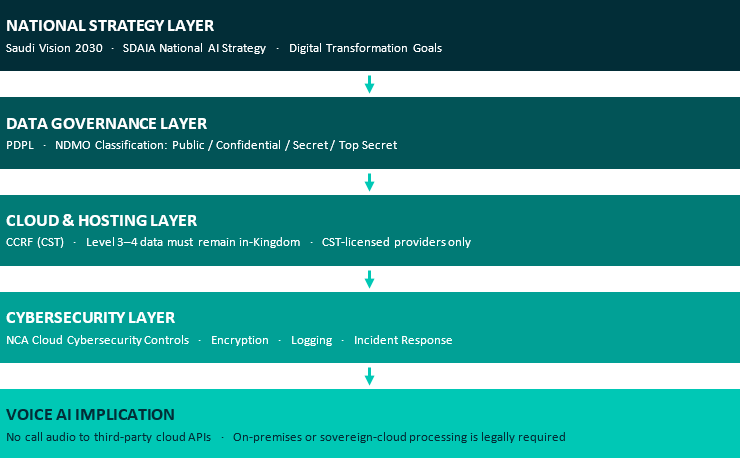
Figure 1 — Saudi Arabia Data-Sovereignty Regulatory Stack for Government Voice AI Deployments
The implication of this regulatory stack is absolute: routing citizen call audio through a third-party, overseas speech API is legally prohibited for classified or personal government data. This is not a procurement preference—it is a legal constraint with criminal penalties.
Even as Saudi Arabia explores more flexible models—such as the draft Global AI Hub Law proposed by CST in April 2025, which would allow foreign entities to host data in the Kingdom under agreed frameworks—government-classified voice data will remain subject to the strictest tier of controls [9]. For government contact centers, the only viable path forward is an on-premises or fully sovereign cloud deployment.
3. The Quality Gap: Why Commercial Arabic Voice AI Falls Short
While the regulatory mandate requires sovereign deployment, the technical reality of commercial Arabic voice AI presents a separate and equally serious challenge: it does not understand how citizens actually speak.
When tested against Saudi-dialect audio benchmarks, commercial speech recognition models typically misunderstand between 37 and 56 percent of the words spoken [10]. An agent that fails to comprehend every third word cannot serve the public. This is not a marginal limitation—it is a fundamental barrier to deployment.
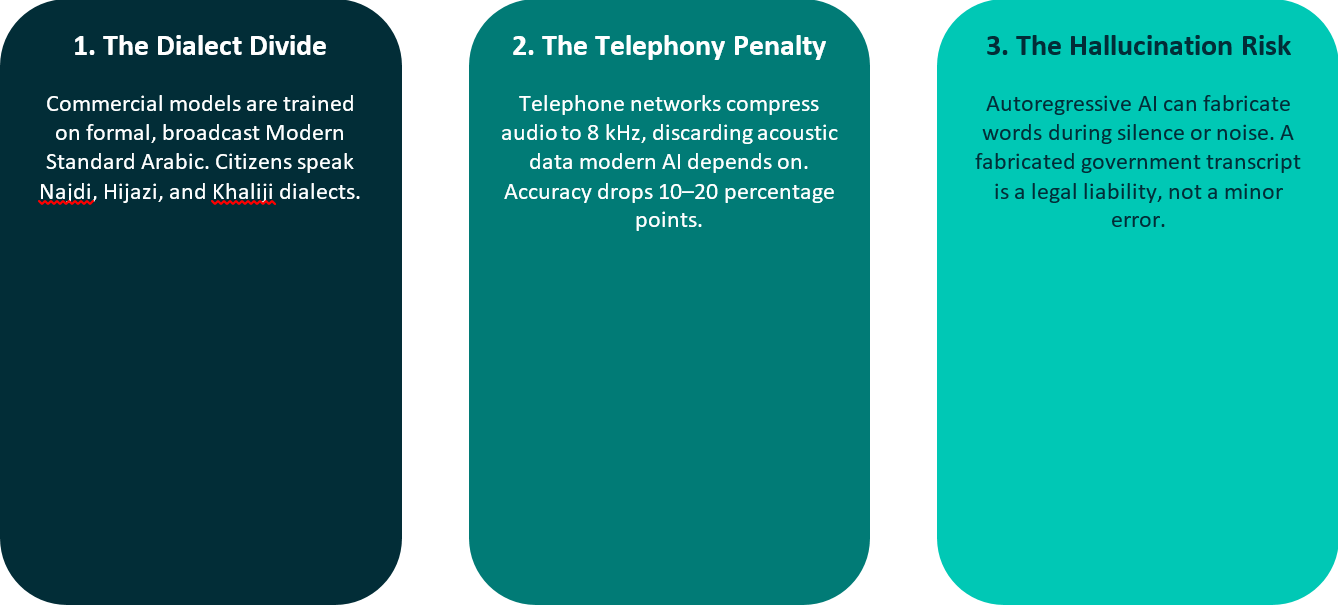
Figure 2 — Three Structural Gaps in Commercial Arabic Voice AI for Government Use
This quality gap stems from three critical mismatches that no amount of configuration can fully resolve in an off-the-shelf product:
The Dialect Divide. Most commercial Arabic AI is trained on Modern Standard Arabic (MSA) and formal broadcast media. Citizens call government hotlines speaking spontaneous, colloquial dialects: Najdi, Hijazi, Khaliji. The gap between MSA and Saudi dialects involves different vocabulary, grammatical structures, and prosodic patterns that a model trained on broadcast Arabic has never encountered.
The Telephony Penalty. Telephone networks compress audio, discarding the high-frequency acoustic data that modern AI models rely upon. A model that performs well on clean studio audio can degrade by 10 to 20 percentage points when applied to a standard phone call.
The Hallucination Risk. Many modern AI models are prone to "hallucination"—inventing words or repeating phrases when they encounter silence or background noise [11]. In a government context, an AI that fabricates a transcript creates direct legal liability. A government agent must be engineered to admit a gap rather than invent an answer.
Furthermore, speech synthesis—the AI's voice—suffers from a similar disconnect. When an AI responds to a Najdi-speaking citizen using a formal, broadcast-Arabic voice, it creates an immediate trust deficit. The system sounds foreign, undermining the citizen's confidence in the service before a single word of content has been evaluated.
4. Sovereign by Design: The EjadTech Approach
Faced with the dual constraints of strict data sovereignty and the inadequacy of off-the-shelf models, EjadTech undertook applied research to build a voice AI agent specifically designed for the Saudi government context. The goal was to prove that an entirely on-premises system—where no audio ever leaves the customer's secure infrastructure—could outperform commercial cloud APIs in dialectal accuracy.
The breakthrough came from abandoning the search for a single "perfect" model. Instead, the research employed a Multi-Model Fusion Architecture: running several specialized speech recognition models simultaneously and using a language model to reconcile their outputs. Where one model fails, another may succeed, and a language model can exploit this disagreement in ways that simple averaging cannot.
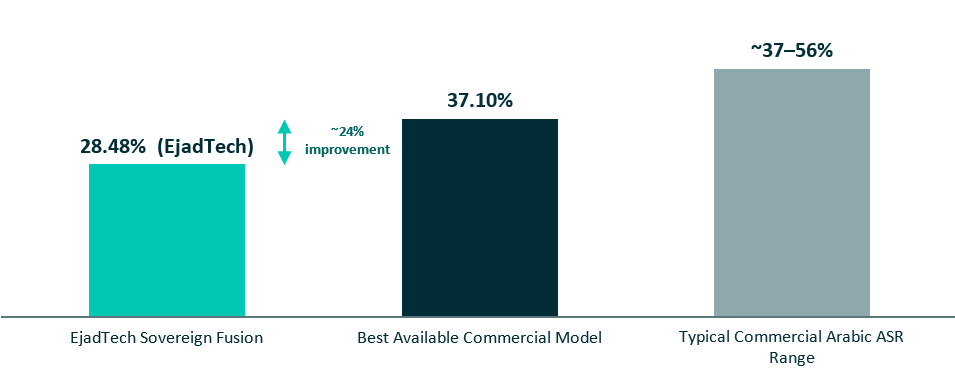
Figure 3 — Accuracy Gap: Sovereign Fusion vs. Commercial Arabic Speech AI (SADA Saudi Dialectal Benchmark)
The result was a 28.48 percent Word Error Rate on the benchmark Saudi dialect dataset—approximately 24 percent better than the best single commercial model available, and well ahead of the 37–56 percent range typical of off-the-shelf Arabic AI [10]. This was achieved entirely on customer-controlled, on-premises infrastructure, with no data leaving the secure perimeter.
Three additional design principles distinguish this approach from a standard software deployment:
Zero-Fabrication by Architecture. Rather than suppressing hallucination through software patches, the system was built on a model architecture that is structurally incapable of fabricating text during silence or noise. Silence returns silence. This provides an absolute guarantee for legal and audit records—not a probabilistic one.
Conversational Responsiveness. Through careful engineering of the system's listening behavior, the delay between a citizen finishing a sentence and the AI responding was cut in half, dropping well below the one-second threshold where callers typically perceive a system failure and abandon the call.
Dialect-Authentic Voice. Utilizing zero-shot voice cloning, the agent speaks in authentic local dialects and registers, drawing fidelity from a reference voice clip rather than a formal MSA training corpus. The AI sounds like a Saudi customer-service representative because it is modeled on one.
5. The Architecture of Sovereignty
The on-premises architecture is not simply a matter of hosting software on a local server. It is a deliberate engineering philosophy that ensures every component of the AI pipeline operates within the government's secure perimeter.
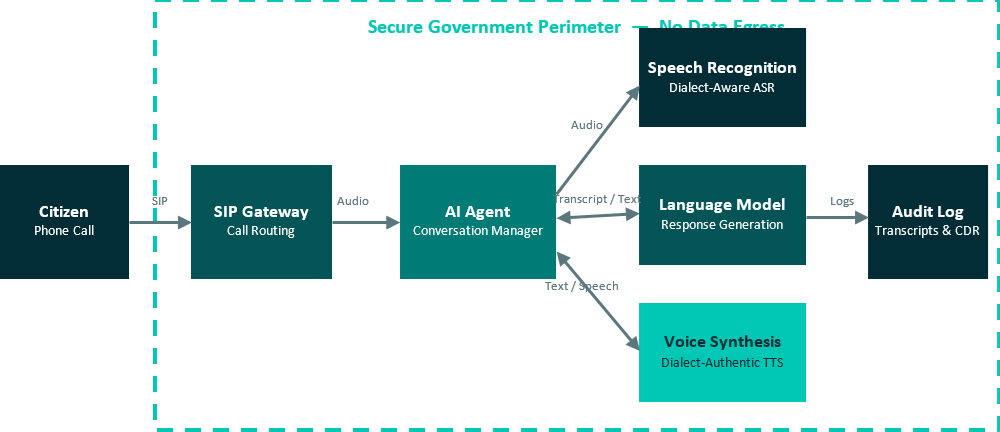
Figure 4 — Sovereign by Design: On-Premises Voice AI Architecture
Calls arrive over standard telephony protocols and are routed to an AI agent that manages the conversation. Critically, the agent itself holds no AI models—it is a lightweight orchestrator. All intelligence (speech recognition, language understanding, and voice synthesis) runs as separate, independently upgradeable services on a single on-premises GPU within the government's secure perimeter. Every call recording, every transcript, and every interaction log is captured and stored locally, compliant with NCA logging requirements and PDPL data subject rights obligations.
The system also carries the operational features that a government telephony environment demands: responses grounded in structured, verified data rather than AI memory; seamless warm transfer to a human supervisor at any point in the conversation; and a full audit trail delivered to backend systems at the end of every call. These are not optional enhancements—they are governance requirements built into the foundation.
6. Global Precedents and the Saudi Context
Saudi Arabia is not alone in pursuing government-grade conversational AI. Several governments have already demonstrated the strategic and operational value of this approach, though each reflects a different sovereignty posture.
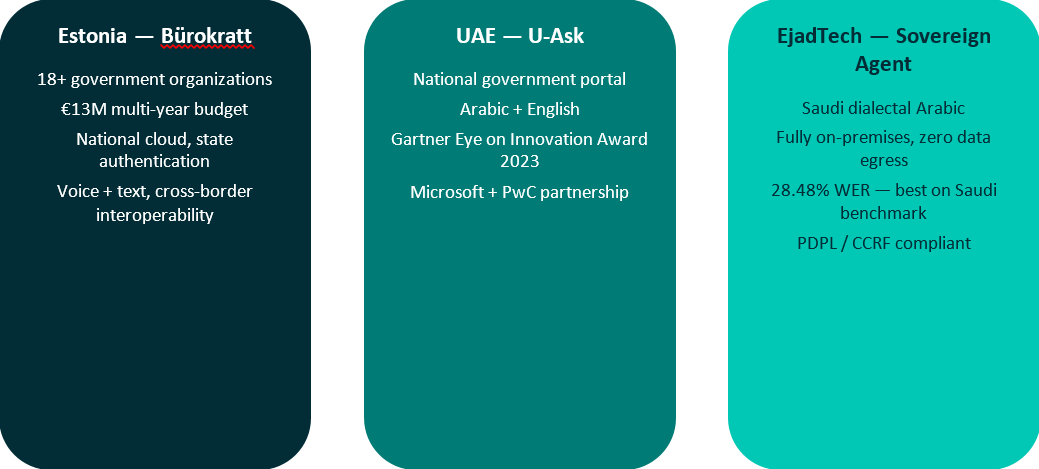
Figure 5 — Global Precedents in Government Conversational AI
Estonia's Bürokratt is the most directly comparable precedent for a government-owned virtual assistant. Built inside a national cloud with state-run authentication, it has connected 18-plus government organizations to a single platform with a €13 million multi-year budget [12]. Its design philosophy—open interfaces, built-in identity and consent, local-language models, and strong guardrails for trust—mirrors the principles underlying the EjadTech approach.
The UAE's U-Ask platform, built through a partnership with Microsoft and PwC, won the Gartner Eye on Innovation Award for Federal Government Initiatives in 2023 [14]. It demonstrates the appetite for government AI in the region, though its public cloud architecture reflects a different regulatory environment than Saudi Arabia's.
The lesson from both precedents is consistent: governments that invest in purpose-built, sovereignty-respecting AI infrastructure are the ones delivering meaningful citizen-service improvements. The question for Saudi government leaders is not whether to adopt voice AI, but how to do so in a way that is compliant, accurate, and built to last.
7. A Framework for Government Procurement
The research and deployment experience described in this paper has produced a set of practical principles for government technology leaders evaluating voice AI solutions. These are not aspirational guidelines—they are minimum standards for responsible procurement.
|
Procurement Principle |
Why It Matters |
How to Verify |
|
Demand dialectal accuracy testing |
Vendor claims based on MSA or clean audio are not representative of real citizen calls |
Require live testing on telephone-band dialectal recordings from your actual citizen base |
|
Mandate zero-fabrication guarantees |
AI hallucination in a government transcript is a legal liability, not a minor error |
Test the system on silence, noise, and tone inputs; it must return empty output |
|
Verify true data sovereignty |
The entire pipeline—ASR, LLM, TTS—must operate within the Kingdom |
Audit the hosting location and operational control model for every component |
|
Require seamless human escalation |
Citizen trust depends on knowing a human is always available |
Test transfer latency and reliability; it must be a first-class feature, not a fallback |
|
Insist on a full audit trail |
Government accountability requires complete, tamper-proof records |
Verify that call recordings, transcripts, and logs are captured locally per NCA requirements |
|
Evaluate for regulatory compliance |
PDPL, CCRF, and NCA CCC are legal obligations, not optional certifications |
Require documented evidence of compliance for each framework, not vendor assurance |
Conclusion
The modernization of government citizen services through AI is inevitable. The question is not whether to adopt voice AI, but whether to adopt it in a way that respects the sovereignty of citizen data, the diversity of citizen dialects, and the legal accountability that public service demands.
The research presented in this paper demonstrates that these requirements are not in conflict. An on-premises, dialect-aware voice AI agent can outperform commercial cloud alternatives in accuracy, eliminate the hallucination risks that make AI unsuitable for legal records, and deliver the seamless, responsive experience that citizens expect—all within the strict boundaries of Saudi Arabia's data-sovereignty framework.
"Sovereign by Design" is not a constraint on innovation. It is the foundation on which trustworthy, lasting public-sector AI is built.
References
[1] Gartner, "Gartner Predicts Agentic AI Will Autonomously Resolve 80% of Common Customer Service Issues Without Human Intervention by 2029," March 2025.
[2] Gartner, "Top Contact Center Trends to Watch in 2025," December 2024.
[3] Market.us, "Voice AI Agents Market Size, Share | CAGR of 34.8%." Available: https://market.us/report/voice-ai-agents-market/
[4] DLA Piper, "Saudi Arabia's new Personal Data Protection Law in force," February 2024.
[5] DPO Consulting, "PDPL — Saudi Arabia's Personal Data Protection Law Explained (2026)," February 2026.
[6] JMM Innovations, "Saudi Arabia Data Sovereignty Guide: NDMO, PDPL & Sovereign Cloud." Available: https://jmminnovations.com/insights/saudi-data-sovereignty-guide
[7] CST, Kingdom of Saudi Arabia, "Cloud Computing Regulatory Framework (CCRF) version 3."
[8] NCA, Kingdom of Saudi Arabia, "Cloud Cybersecurity Controls (CCC-1:2020)." Available: https://nca.gov.sa/ccc-en.pdf
[9] CST, "Public Consultation for the Global AI Hub Law," April 14, 2025. Available: https://www.cst.gov.sa/en/media-center/news/N2025041401
[10] Alharbi, A. & Alowisheq, A., "SADA: Saudi Audio Dataset for Arabic," IEEE ICASSP 2024.
[11] DEV Community, "Whisper Hallucination on Silence: Why Your Transcript Loops the Same Phrase," April 2026.
[12] e-Estonia, "Estonia's new virtual assistant aims to rewrite the way people interact with public services," January 2022.
[13] GovInsider, "Estonia eyes cross-border interoperability for Bürokratt," October 2025.
[14] TDRA, UAE, "Awards: Gartner Eye on Innovation Award 2023," 2023.